- Titanium has decades of research behind it and remains the standard. Zirconia is a newer, white, metal free ceramic with a much shorter record.
- A 2023 meta-analysis estimated that 97.2% of zirconia implants were still in place after five years, similar to titanium at that point, though from only 277 implants.
- Zirconia's strengths are its color under thin gum and having no metal. Its limits: less long-term data, fewer prosthetic options and less room to adjust the angle.
- Titanium allergy appears to be uncommon. The choice is best made after a 3D scan and a careful look at your gum, bone and bite.
Zirconia vs titanium implants: the short answer
Both are reliable ways to replace the root of a missing tooth. Titanium has decades of research behind it and is still the international standard. Zirconia, a white ceramic, is the main metal free alternative: its five year results look similar to titanium's, but it has far less long-term data, so the better choice depends on the site, your gum and bone, your bite and what matters most to you.
What is the difference between zirconia and titanium implants?
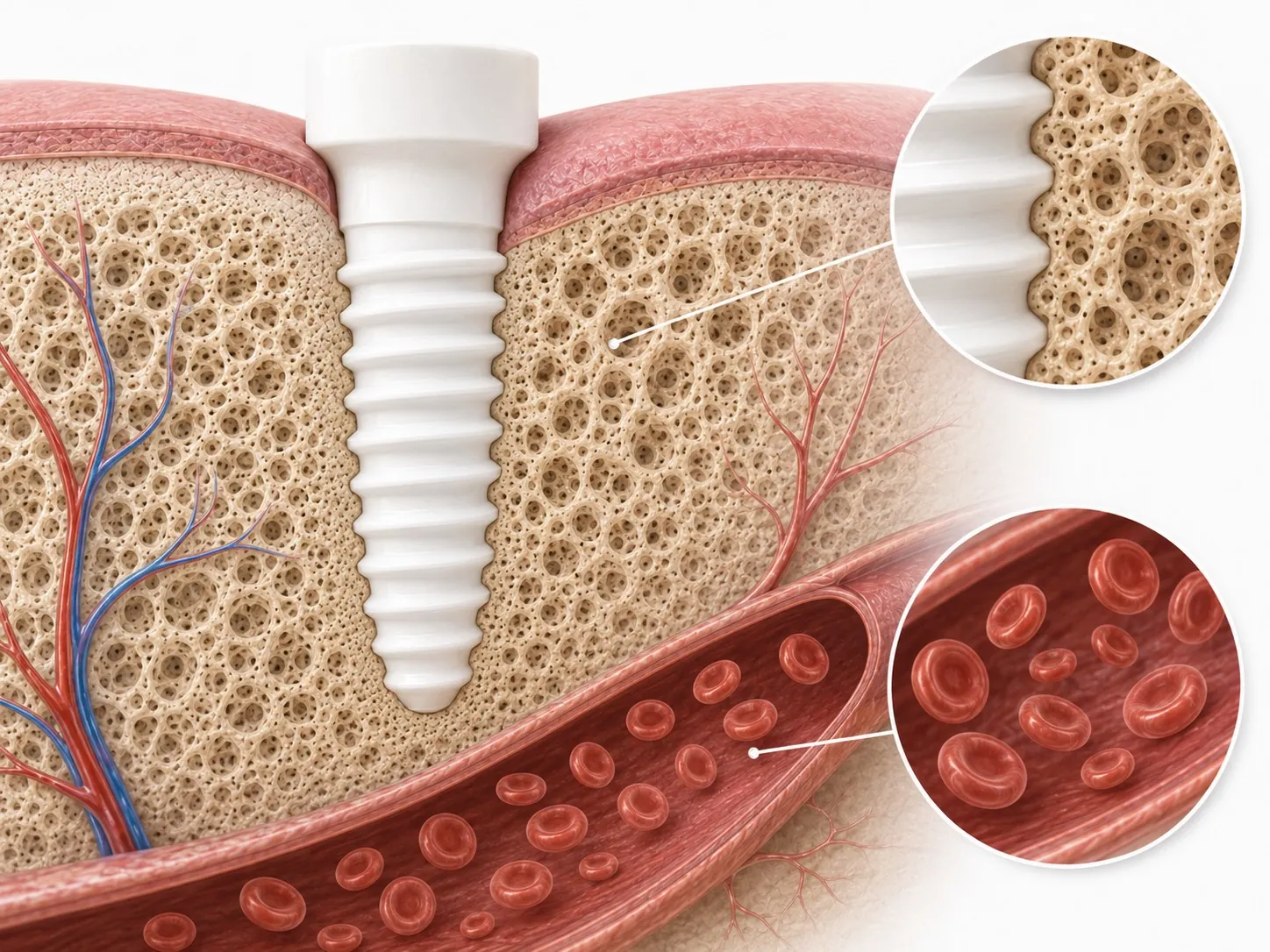
An implant is the part that sits in the jawbone in place of a tooth's root. An abutment connects it through the gum to the crown you see. According to the U.S. Food and Drug Administration, most implant systems are made of titanium or zirconium oxide, better known as zirconia. Here is how ceramic vs titanium implants compare at a glance:
- Track record. Titanium has been used for many decades, and studies have followed titanium implants for 20 years. Zirconia implants arrived in the early 2000s, and pooled data mostly reach about five years.
- Color. Titanium is dark gray. Zirconia is white, close to the color of a natural tooth.
- Metal. Titanium is a metal. Zirconia is a ceramic, though some two-piece ceramic systems use a metal screw.
- Toughness. Zirconia is strong enough for chewing, but it is more brittle, and titanium is much tougher.
- Design. Zirconia comes in one-piece and two-piece designs, and two-piece ceramic systems are still limited in number.
How long do titanium implants last?
The German S3 guideline on ceramic implants, developed by the German Society for Implantology, describes titanium as the international standard for replacing missing teeth because of its excellent long-term data.
Reviews of titanium implants consistently report survival well above 90% at 5 and 10 years. A 2024 meta-analysis of studies that followed rough-surface titanium implants for 20 years still estimated that roughly four in five or more were in place, depending on how the studies were designed and how patients lost to follow-up were counted. Survival means the implant is still there, which is not the same as trouble free, and the authors stress that follow-up should not stop after the first decade.
What does the research say about zirconia implants?
One of the most useful summaries so far is a 2023 systematic review and meta-analysis by Roehling and colleagues, prepared for an International Team for Implantology (ITI) consensus conference. It pooled six clinical studies of zirconia implants still on the market, each with an average follow-up of at least five years. After five years of use, it estimated:
- Survival: 97.2% of implants still in place (277 implants in 221 patients).
- Bone loss around the implant: about 1.1 mm on average.
- Probing depth, a measure of the gum pocket around the implant: about 3.0 mm on average.
The authors found these figures similar to five year data for titanium, where earlier reviews reported survival between 95.6% and 97.2%, and concluded that current zirconia implants are a reliable option for up to five years.
The same paper is candid about the limits. Its 277 zirconia implants compare with more than 3,200 in similar titanium reviews. All six studies were observational, five of them looked at one-piece implants, and at the time only one randomized trial had compared a zirconia implant still on the market directly with titanium: 16 zirconia and 14 titanium implants, all still in place after a year. The authors call for more long-term studies and randomized trials. The German guideline adds one reason the long view is slow to arrive: zirconia products keep being improved and replaced, which makes data beyond five years hard to collect. It also says early findings of less plaque on zirconia are not yet enough to conclude that ceramic implants lower the risk of peri-implantitis, the inflammation that can develop around implants.
Do zirconia implants look more natural?
This is zirconia's clearest advantage, in the right mouth. Titanium's color can show through the gum as a grayish shadow, which one review calls its most important disadvantage. A 2024 review in the British Dental Journal notes that it matters most when the gum is thin and the smile line is high.
The evidence is more mixed than the marketing. A 2023 systematic review of randomized trials comparing zirconia and titanium abutments, the part that passes through the gum, found no significant difference in aesthetic outcomes, and pointed to gum thickness as an important factor. So color is mainly a question for front teeth, where the gum shows when you smile.
Can you be allergic to titanium implants?
It is possible, but it appears to be uncommon, and the topic is debated.
The mainstream view. Most researchers consider titanium one of the least allergenic metals used in medicine, and the FDA notes that implant systems go through biocompatibility testing for reactions such as irritation or allergy. The British Dental Journal review puts the estimated prevalence of titanium allergy at about 0.6%, based on a study of 1,500 implant patients, with positive reactions more likely in people who had allergy-like symptoms after placement or an unexplained implant failure. A 2020 scoping review called titanium allergy uncommon but real, with evidence drawn mostly from individual case reports, and found that testing lacks standardization: the usual skin patch test misses some metal allergies, and researchers disagree about a laboratory test called MELISA.
The biological dentistry view. A biological dentist looks at the individual: what is this person's history with metals, and what do they want in their mouth? People who already react to other metals appear more likely to react to titanium, and the 2020 review advises a titanium allergy test for anyone with a history of metal allergy. For those patients, and for people who would simply rather have no metal in their body, zirconia offers a choice. That is a preference and a precaution, not evidence that titanium is unsafe for most people.
One-piece or two-piece zirconia implants?
Zirconia implants come in two designs, and the difference matters.
- One-piece. The root and the post that holds the crown are a single piece of ceramic with no joint, and the crown is cemented on much as it would be on a natural tooth. Most of the five year data come from this design, and the German guideline supports one-piece zirconia as an alternative to titanium. The trade-off is precision: the post often cannot be reshaped or re-angled later, and the British Dental Journal review notes that a badly angled one-piece implant may have to be removed. It also comes through the gum from day one, so it takes some load while it integrates and is often protected with a cap.
- Two-piece. The abutment is a separate part, as on a two-piece titanium implant. That allows angled or adjustable abutments and more prosthetic options, and the implant can integrate under the gum without load, with bone grafting at the same time if needed. These systems reached the market later and have less research behind them, so the German guideline recommends them only after patients are told in detail about the lack of long-term data.
If your goal is metal free implants, ask about the screw. Some two-piece ceramic systems attach the abutment with a titanium or gold screw, while others use carbon or ceramic.
What are the disadvantages of zirconia implants?
- A shorter record. Pooled data mostly reach five years, and two-piece ceramic systems have the least long-term evidence.
- A more brittle material. Fracture was a real problem with some early ceramic implants. One early zirconia design, withdrawn from the market in 2006, fractured in 13 of 170 implants, 12 of them narrow ones, which researchers linked to flaws from an uncontrolled manufacturing process. An earlier analysis by Roehling's group found that reported fracture rates fell from 3.4% to 0.2% as designs improved between 2004 and 2017.
- Less room to correct the angle, especially with one-piece designs.
- Fewer prosthetic options. One-piece implants are the least flexible, and two-piece ceramic systems, which offer more, are still limited in number.
Cost is part of the decision too. What drives the price, and what a complete quote should include, is covered in a separate article on zirconia implants cost.
Who is a good candidate for each?
Titanium may suit you if
- You want the option with the longest research record behind it.
- Your treatment needs the flexibility of a two-piece design, where titanium has far more long-term data than ceramic.
- Having metal in your body is not a concern for you.
Zirconia may suit you if
- You want a metal free mouth, for example after your old amalgam fillings have been removed safely.
- You have a confirmed allergy to titanium or other metals.
- The implant replaces a front tooth and your gum is thin or shows when you smile.
- Your bone and the position of the tooth allow the precise placement a one-piece design needs.
How do you decide with your dentist?
The choice is made for a specific site in a specific mouth. A thorough consultation covers:
- 3D imaging. A cone beam CT scan shows the height and width of the bone and where the nerve and sinus sit, so the dentist can plan the implant's size, position and angle and see whether bone grafting is needed.
- Gum and smile line. How thick the gum is and how much of it shows when you smile.
- Your bite. Clenching and grinding load any implant, and heavy forces are one of the factors in fractures of ceramic parts.
- Your health history. The FDA notes that your overall health and smoking can affect your recovery and how long an implant lasts. Any metal allergy belongs in the conversation too.
- The exact system. Ask for the brand and model, whether it is one-piece or two-piece, what any screw is made of, and how long that system has been studied. The FDA suggests keeping the brand and model in your records.
Zirconia implants with Dr. Panahpour
Zirconia has been part of Dr. Panahpour's practice since 2001, and he sees patients in Santa Monica and Sacramento. If you are weighing ceramic against titanium, a consultation with 3D cone beam imaging shows whether a ceramic implant suits the site and what the alternatives would involve. Every implant is planned around your bite as well as the bone. You can read how treatment works on the zirconia implants page, or request a consultation below.
Common questions
Are zirconia implants better than titanium?
Neither is better for everyone. Titanium has the longest research record and remains the standard. Zirconia is white and metal free, with five year results similar to titanium's in the studies so far, but far less long-term data. The right choice depends on the site, your gum and bone, your bite and your priorities.
How long do zirconia implants last compared with titanium?
A 2023 meta-analysis estimated that 97.2% of current zirconia implants were still in place after five years, similar to titanium at the same point. Titanium also has studies that followed implants for 10 and 20 years, while zirconia does not yet have long-term data on that scale.
Are zirconia implants as strong as titanium?
Modern zirconia is strong enough for normal chewing, but it is more brittle, and titanium is much tougher. Fractures were a problem with some early ceramic designs that have since been withdrawn, and reported fracture rates dropped sharply as designs improved.
Can you be allergic to titanium dental implants?
It is possible but appears to be uncommon. A 2024 review estimates the prevalence at about 0.6%, based on a clinical study of 1,500 implant patients, and reviews describe the evidence as limited and testing as imperfect. People who already react to other metals may be more likely to react, so mention any metal allergy before treatment.
Are zirconia implants completely metal free?
One-piece zirconia implants are a single piece of ceramic. Two-piece systems join the abutment with a screw that may be titanium, gold, carbon or ceramic, so if you want no metal at all, ask what the screw is made of.
What is the difference between one-piece and two-piece zirconia implants?
In a one-piece implant, the root and the post for the crown are a single unit. Most of the five year ceramic data come from this design, but the angle cannot easily be corrected later. A two-piece implant has a separate abutment, which gives more flexibility, but two-piece ceramic systems have less long-term research behind them.
Sources
- Roehling S, Gahlert M, Bacevic M, Woelfler H, Laleman I. Clinical and radiographic outcomes of zirconia dental implants: a systematic review and meta-analysis. Clinical Oral Implants Research. 2023;34(S26):112-124
- Laleman I, Lambert F, Gahlert M, Bacevic M, Woelfler H, Roehling S. The effect of different abutment materials on peri-implant tissues: a systematic review and meta-analysis. Clinical Oral Implants Research. 2023;34(S26):125-142
- Thiem DGE, Stephan D, Kniha K, et al. German S3 guideline on the use of dental ceramic implants. International Journal of Implant Dentistry. 2022;8:43
- Bollen C, Hakobayan G, Jörgens M. One-piece versus two-piece ceramic dental implants. British Dental Journal. 2024;236(5):383-387
- Comino-Garayoa R, Cortés-Bretón Brinkmann J, Peláez J, López-Suárez C, Martínez-González JM, Suárez MJ. Allergies to titanium dental implants: what do we really know about them? A scoping review. Biology. 2020;9(11):404
- Kupka JR, König J, Al-Nawas B, Sagheb K, Schiegnitz E. How far can we go? A 20-year meta-analysis of dental implant survival rates. Clinical Oral Investigations. 2024;28(10):541
- U.S. Food and Drug Administration: Dental implants, what you should know

Holistic and biological dentistry since 1994, in Santa Monica and Sacramento. IAOMT accredited and SMART certified. Fourth generation dentist and author of The Good Dentist.
Related: Zirconia Implants in Santa Monica · Safe Mercury Filling Removal in Santa Monica
This article is general education, not medical or dental advice. Every mouth and every health history is different; please talk to a licensed professional about your own situation.